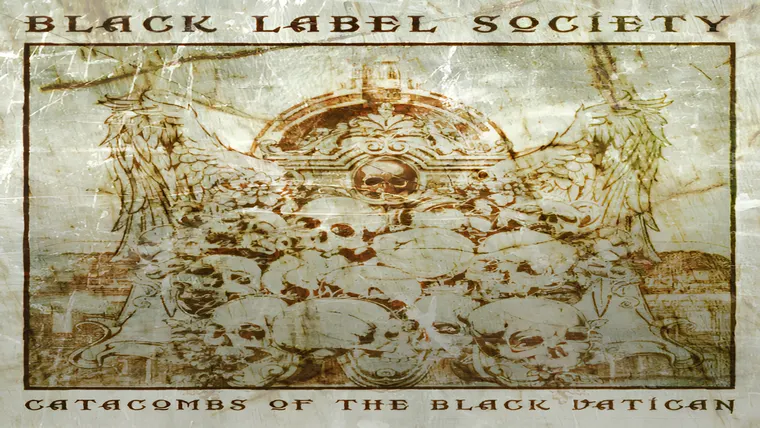
Released: April 8, 2014
Nobody came to a Black Label Society record wondering whether Zakk Wylde could play. By 2014, the solos, squeals, and bulldozer riffs were part of the deal. The interesting question on Catacombs of the Black Vatican is what happens when he gives the songs first, say. How much does Black Label Society gain when the guitar has to answer to the song?
Recorded at Wylde’s Black Vatican studio with John DeServio on bass and Chad Szeliga on drums, the album came together quickly. Wylde had roughly 25 days to write before the band arrived, and that short runway shows up in the directness of the heavier songs. “Fields of Unforgiveness” moves on a low, blunt riff while DeServio’s bass pulses underneath it. Wylde stacks his voice into a worn harmony that brings some Alice in Chains colouring without pulling the song away from BLS. “My Dying Time” pushes that idea further: The riff drags, Szeliga keeps a steady roll, and the layered chorus sounds as tired as the words.
“Believe” shows how much Wylde can do with fewer moving parts. It plants a detuned, Sabbath-shaped riff and waits for the groove to settle. A vibraslap flicks between the speakers before the riff drops back in, while the guitar squeals land as accents and leave the main rhythm alone. “Beyond the Down” tightens that approach into less than three minutes, with DeServio and Szeliga sitting high enough in the mix to give the choppy riff its bounce. On “Damn the Flood,” the band drops into half-time before the lead break. The solo can sprint because the rhythm section has opened a lane for it. Its repeating pentatonic run belongs to the arrangement instead of sitting on top of it.
The quieter songs make Wylde’s discipline even easier to hear. He wrote “Angel of Mercy” on piano before moving it to guitar, and the chord movement still follows the vocal closely. Acoustic guitar holds the song together, strings widen the chorus, and the electric lead follows the melody before picking up speed. “Scars” leaves even more room. Its acoustic strum and piano surround a lower, worn-down vocal, while the solo uses a clean, rounded tone and long Dickey Betts-style bends. Wylde’s usual high-gain scream would have broken the mood. Here, he lets the notes hang.
The album sometimes divides these two sides too neatly. A run of heavy songs stops for a ballad, starts again, and then makes another sharp turn. It can sound like two BLS moods taking turns. The stronger moments let them mix. “I’ve Gone Away” threads pinch harmonics through a vocal-led groove and uses them as punctuation. “Empty Promises” stretches past five minutes, moving from a slow, ugly riff into a chorus with more air around it. Wylde never has to choose between songwriter and guitarist because the two parts keep adjusting to each other.
That also explains why “Shades of Gray” needs its six and a half minutes. Written on acoustic guitar, it takes a simple bluesy progression and gives the vocal room to circle doubt, isolation, and damage before the solo enters. The long notes say more than another burst of speed because the song has already settled into its sadness.
So what does Black Label Society gain when Wylde gives the songs first say? The guitar starts revealing something about the music instead of repeating what everyone already knows about the player. The bruised harmonies in “My Dying Time,” the open space in “Scars” and the half-time drop in “Damn the Flood” each pull a different performance from him. Catacombs of the Black Vatican still has plenty of excess. For once, the songs decide where it goes.
