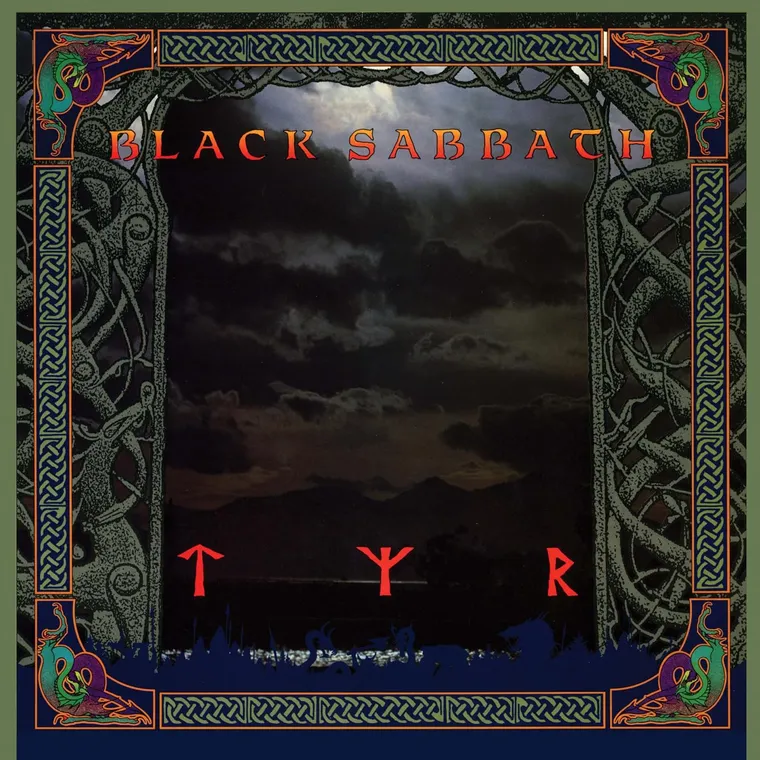
Released: August 20, 1990
By 1990, Black Sabbath barely resembled the band that recorded “Paranoid.” Tony Iommi was the only original member left, the drums were enormous, keyboards were everywhere, and Tony Martin was singing about Norse mythology. Tyr raises a fair question: how much can Sabbath change before it stops sounding like Sabbath?
Released August 20, 1990, through I.R.S. Records, Tyr was the band’s fifteenth studio album. Iommi, Martin, drummer Cozy Powell, keyboardist Geoff Nicholls, and bassist Neil Murray—who joined during the Headless Cross tour—recorded his debut Sabbath album. Iommi and Powell produced the record, the songs were credited collectively to the band, and Martin wrote the lyrics.
The title and runes on the cover suggest a complete Viking concept album. That description falls apart once the music starts. Murray later explained that the Norse material was an attempt to move beyond Sabbath’s usual demons and darkness, but nobody planned a single overarching story. There are songs about faith, judgment, and spiritual uncertainty, plus one love ballad that sticks out like it wandered into the wrong recording session.
“Anno Mundi” immediately establishes how different this version of Sabbath sounds. Acoustic guitar and layered voices introduce the song before Iommi drops in a slow, deliberate riff. Powell’s drums take up a giant chunk of the mix, while Martin moves from a measured opening into a chorus that stretches well above the guitar. The basic Sabbath ingredients are there, but everything surrounding them has changed.
Powell ensures that his presence behind the kit is unforgettable. His double-kick work drives “The Law Maker,” while “Heaven in Black” gives him a faster guitar pattern and plenty of space to push through the transitions. He plays with enough force to change the shape of both songs.
This comes with a price. Murray later admitted he wanted a bigger bass sound and thought the finished mix favored Powell’s drums. He had a point. The bass rarely gets the space it had on earlier Sabbath records, which means the rhythm section often sounds like Powell leading the charge while Murray works underneath him.
Nicholls also plays a larger role than the band’s earlier records might suggest. His keyboards fill out the arrangements, soften the edges around Iommi’s guitar, and give the music an almost ceremonial atmosphere. “Jerusalem” combines Martin’s rising vocal melody with sustained keyboard lines and sharp guitar harmonics. “The Sabbath Stones” moves between quieter passages, a dragging central riff, and a quicker section that shifts the song into another gear.
That combination of patience, melody, and sudden acceleration brings the central question back into focus. Sabbath sounds different here, but Iommi still controls the direction of the songs.
The three-song run of “The Battle of Tyr,” “Odin’s Court” and “Valhalla” makes that especially clear. Nicholls starts with a short keyboard instrumental before the music settles into acoustic guitar and Martin’s quieter delivery. Then Powell comes down hard, Iommi introduces the main riff, and “Valhalla” pulls the whole sequence together. The mythology is specific to these songs, but the movement from subdued buildup to a heavier payoff comes straight from Sabbath’s established playbook.
“Feels Good to Me” interrupts that atmosphere with a polished power ballad. Martin sings it well, and Iommi contributes a controlled solo, but placing a love song between “Valhalla” and “Heaven in Black” makes the change in mood impossible to miss. Murray later suggested it was chosen as a single because it had the best chance of getting played on MTV. That explains its presence, even if it still sounds like a detour.
So, how much can Sabbath change before it stops sounding like Sabbath? Tyr suggests the band can change quite a bit, provided Iommi is still shaping the songs. The drums get bigger, the keyboards spread out, and the lyrics visit Odin’s court, but the riffs underneath “Anno Mundi,” “The Sabbath Stones” and “Valhalla” still point back to the same place.
A ThisDayInMetal exclusive by Rob Joncas, founder of DeadNoteMedia.
