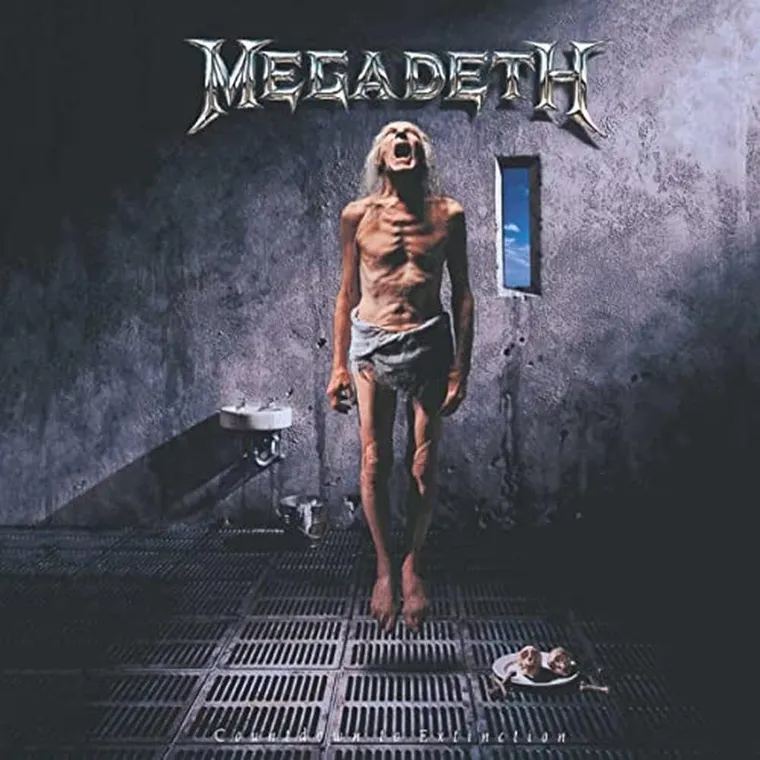
Released: July 14, 1992
Rust in Peace pushed Megadeth’s technical side about as far as it could go. The playing was rapid, tangled, and exact, with songs that could change direction three times before most bands reached the chorus. Trying to top it by becoming even more complicated was possible, but probably pointless.
Countdown to Extinction goes the other way. Megadeth slows down, shortens the songs, and lets the riffs repeat long enough to stick. The central question becomes clear: how much complexity can the band remove before it stops sounding like Megadeth?
“Symphony of Destruction” gives the most direct answer. Its main riff is almost suspiciously simple by Megadeth standards. The drums march, the bass locks in underneath, and Dave Mustaine leaves plenty of room around the vocal. Yet nobody could mistake it for another band. His clipped delivery, political disgust, and crooked sense of melody remain intact.
That distinction matters. Megadeth’s identity was never built entirely on speed or technical excess. It came from the way Mustaine arranged riffs, placed words, and made even the catchiest ideas sound slightly unstable. The songs could become simpler without becoming comfortable.
The band does not abandon precision. It redirects it.
Nick Menza plays with the song instead of constantly pushing against it. David Ellefson gives the slower riffs a heavy centre. Marty Friedman’s leads still wander into strange melodic territory, but they arrive in shorter, sharper bursts. Nobody is playing below their ability. They are choosing where to use it.
That restraint also gives Mustaine more room as a character.
“Sweating Bullets” plays like a one-man stage performance, with Mustaine arguing against different versions of himself. The guitar follows his nervous phrasing instead of simply driving underneath it. “Skin o’ My Teeth” moves quickly, but its tight structure keeps the panic contained. “Foreclosure of a Dream” turns economic collapse into something personal, using quieter sections to make the heavier passages land harder.
The title track may be the album’s strongest example of Megadeth reaching a wider audience without sanding down its personality. Its subject is trophy hunting and the destruction of wildlife, but the band avoids turning it into a lecture. The bass creeps forward, the vocal stays controlled, and the chorus arrives with an unsettling calm. The song is accessible, but there is nothing reassuring about it.
The streamlined approach does expose a few weaknesses. “Psychotron” locks onto its central idea and does not develop much beyond it. “Captive Honour” leans heavily on spoken dialogue and courtroom theatre. With fewer moving parts, a weak riff or thin concept has nowhere to hide.
Then “Ashes in Your Mouth” closes the album by letting some of the old complexity back in. The riffs become busier, the arrangement stretches out, and Mustaine and Friedman trade leads with the sharpness expected from this lineup. It works because the album has spent so much time holding that side of the band in reserve.
Countdown to Extinction does not prove Megadeth could become a conventional hard rock band. It proves the band could bend a more conventional structure around its own personality. The songs became cleaner and easier to follow, but Mustaine’s paranoia, sarcasm, political anger, and awkward melodic instincts remained untouched.
So how much could Megadeth simplify before it stopped sounding like Megadeth?
Quite a lot. Speed and constant movement were never the whole identity. Once those were stripped back, the band’s real signature became easier to hear.
Written by Rob Joncas
Founder of DeadNoteMedia—album writing built on music, memory, and meaning.
