The Day Lars Ulrich Became the Internet’s Villain

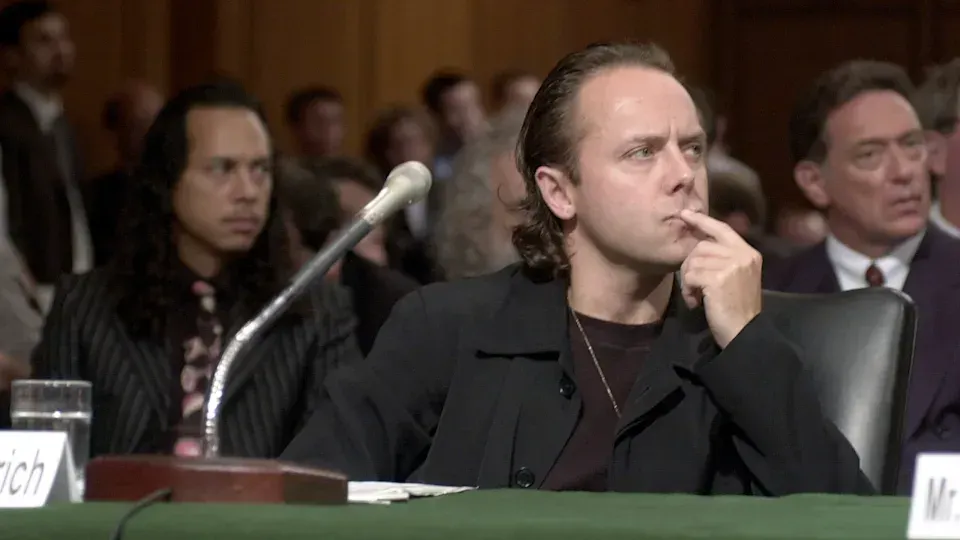
On July 11, 2000, Lars Ulrich sat behind a microphone in Washington and argued that musicians should control what happens to their music.
It should have been an easy position to defend.
Instead, his appearance before the U.S. Senate Judiciary Committee became one of the defining images of the Napster era. Lars was no longer simply the drummer from Metallica. To a large part of the internet, he was now a millionaire rock star asking politicians to stop fans from downloading songs.
How did Lars become the bad guy for saying artists should have a say in how their work was distributed?
The fight began after an unfinished version of “I Disappear,” recorded for the Mission: Impossible 2 soundtrack, found its way onto Napster and then radio. Metallica investigated and discovered that its entire catalogue was being traded through the service.
The band sued Napster in April 2000, arguing that the company had built its business around widespread copyright infringement.
Lars arrived at the Senate hearing with numbers. Metallica had monitored Napster for 48 hours and claimed more than 300,000 users had made roughly 1.4 million downloads of the band’s music.
His basic point was reasonable. A musician could sell a song, give it away, or release it online for free. The important part was that the musician should make that choice.
“We should decide what happens to our music,” he told the committee.
That argument has aged better than the public reaction surrounding it.
The real damage had already been done. Metallica had delivered Napster a list of more than 300,000 usernames accused of sharing the band’s songs. Napster responded by blocking those accounts.
Metallica had not handed over fans’ real names, but that was irrelevant. The stunt looked like one of the biggest bands in the world had personally turned in hundreds of thousands of its listeners.
Lars later admitted that arriving with a truckload of paperwork may not have been the smartest public-relations decision. That is an understatement.
The conversation quickly stopped being about copyright, ownership, or consent. Fans were laughing at Metallica, making parody videos and treating Lars as the face of a record industry that had spent years charging high prices for CDs containing one or two songs people actually wanted.
Napster also offered something the industry had failed to provide.
Listeners could immediately find rare tracks, live recordings, imports, and bands they had only read about. It was fast, simple, and built around how people actually wanted to hear music. The record labels had nothing legal that came close.
Lars was defending the rights of artists, but he was also defending an outdated system that gave fans fewer choices and charged them more money. That made his argument much harder to hear.
None of this made Napster innocent. Its service depended heavily on users trading copyrighted recordings without permission. The courts agreed that Napster could be held responsible for helping and benefiting from that infringement. Metallica eventually settled its lawsuit with the company in 2001.
The band had a solid legal argument.
Publicly, it was a disaster.
Lars saw a technology company using Metallica’s work without permission. Fans saw a wealthy drummer standing beside politicians and record executives, trying to shut down the future.
The years since have proved that his concerns were not ridiculous. Music became digital, but the same questions followed it. Who controls the work? Who gets paid? How much power should technology companies have over the artists supplying their content?
Streaming solved the access problem, but it never completely solved the payment problem. Musicians still argue that platforms earn far more from music than the people making it.
Lars was right that artists deserved control over their work.
He became the villain because Metallica delivered that message by targeting its listeners. Once the band arrived with hundreds of thousands of usernames, the argument stopped looking like artists against a powerful technology company.
It looked like Metallica against its fans.
And in the early days of the internet, there was only ever going to be one winner in that fight.
Written by Rob Joncas
Founder of DeadNoteMedia—album writing built on music, memory, and meaning.