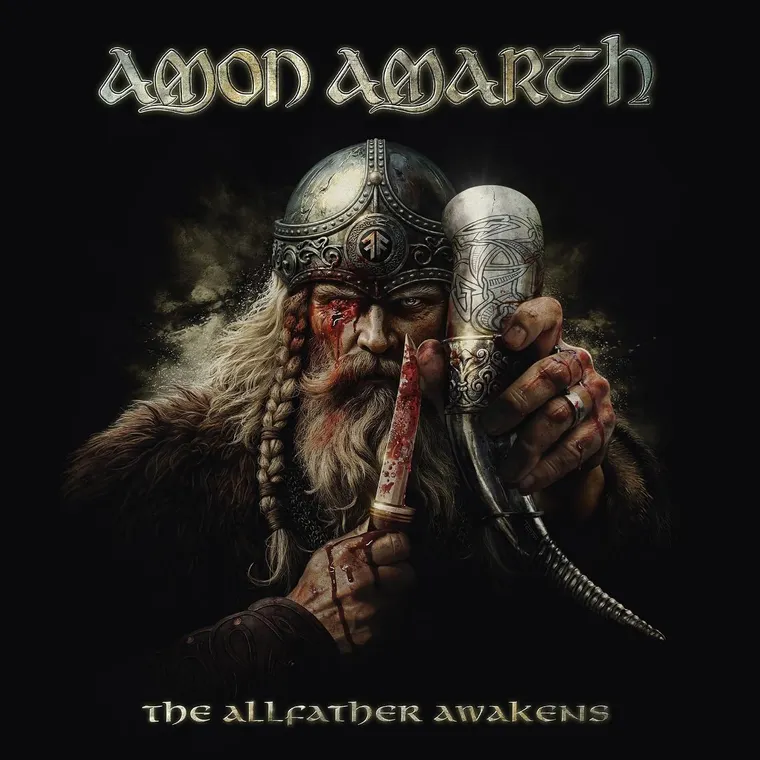
There comes a point with a band like Amon Amarth where change becomes a strange proposition. Nobody puts on one of their records, hoping Johan Hegg has discovered synth-pop. The guitars should gallop, the drums should sound ready for battle, and somebody is probably going to mention Oden before long.
So after nearly three decades of Amon Amarth sounding unmistakably like Amon Amarth, how much can they change the machinery without losing what makes it work?
The Allfather Awakens mostly answers that through smaller decisions.
“Gjallarhorn” opens with the familiar ingredients, but the guitars do more than supply weight. Olavi Mikkonen and Johan Söderberg thread melodic lines through the main riff while Jocke Wallgren keeps the song moving with double-kick underneath. Hegg sits in the middle of it all, delivering the mythology in that deep growl that has become almost conversational through repetition.
“Eight Legs of Thunder” takes the Sleipnir story and builds the music around it. The rhythm gallops because the song is about Oden’s eight-legged horse, a choice that could easily drift into parody, but the guitar melody keeps it grounded. “Kvasir’s Blood” takes a darker route. The opening riff has more menace to it, while the chorus widens the song without cleaning up its rougher edges.
That matters because Amon Amarth have spent years refining a very recognizable songwriting language. The risk now isn’t forgetting how to write these songs. It’s becoming too predictable with them.
Then “Upphaf” changes the shape of the record.
As the first fully acoustic song in Amon Amarth’s catalogue, it could have been treated like a gimmick. Instead, acoustic guitars replace the usual wall of distortion while Hegg delivers adapted lines from the Völuspá in a measured, almost recited growl. Strip away the distortion and the band is still recognizable. The melody survives. So does the atmosphere.
That makes what follows hit differently.
“Die With a War Cry” brings back the electric guitars with slower chugs and tremolo-picked passages that drag some older death-metal dirt into the room. Ted Lundström and Wallgren settle into the heavier pace instead of immediately pushing the song into another sprint.
“Raven God” turns toward twin-guitar melody and a chorus built for a crowd, while “The Allfather Awakes” runs on a direct riff and one of the album’s more immediate vocal hooks. Neither song changes the band’s vocabulary. They just use it with a little more space between the familiar pieces.
“Oden’s Hunt” gives the rhythm section more room to drive. Wallgren hammers underneath a fast guitar figure that matches the chase in the lyrics without needing much decoration. “Ascending Like an Eagle,” meanwhile, stretches past six minutes and lets its guitar themes hang around long enough to develop instead of rushing toward another chorus.
That gets back to the question.
Amon Amarth don’t need to rebuild themselves because the core of the band still works. What The Allfather Awakens shows is that they can loosen the formula without losing the identity. An acoustic song can sit beside tremolo-picked death metal. A myth about Sleipnir can shape the rhythm of a riff. Melody can carry a section where another huge chorus might have been the easier move.
After thirteen albums, the useful changes are the ones that make the old machinery behave a little differently.
A ThisDayInMetal Guest Post written by Rob Joncas, founder of DeadNoteMedia. Artist information and music courtesy of the band.
© 2026 DeadNoteMedia. All rights reserved.
