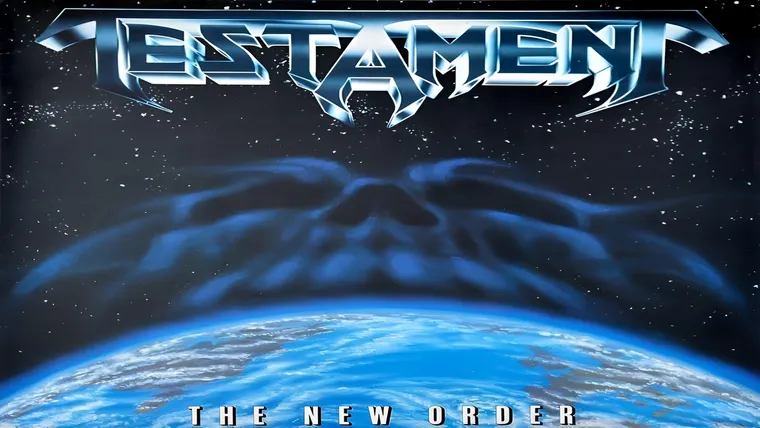
Released: May 10, 1988
Most of The New Order’s best-known songs were built to set a room off: “Into the Pit,” “Trial by Fire,” “Disciples of the Watch.” Yet Testament spends a surprising amount of its 39 minutes holding back the full band. Clean-guitar openings, two instrumentals, and an Aerosmith cover divide the rush into smaller pieces. Why keep making those detours on a record with riffs this direct?
Released through Megaforce/Atlantic in 1988, The New Order followed The Legacy by roughly a year. Testament again consisted of Chuck Billy, Eric Peterson, Alex Skolnick, Greg Christian, and Louie Clemente. At Pyramid Sound in Ithaca, producer Alex Perialas gave the album a lean, fairly dry sound. Peterson’s palm-muted guitar has a coarse edge, Clemente’s snare cuts through cleanly, and Christian’s bass remains audible beneath the guitars. The mix leaves every rhythmic shift clear, which matters because these songs rarely sit on one idea for long.
“Eerie Inhabitants” lays out the method immediately. A roll of thunder, a clean figure, and Skolnick’s rising lead create a cold opening before Peterson enters with a jagged, stop-start riff. Billy begins with an almost narrated delivery, then stretches into sharper cries as the arrangement opens. “Trial by Fire” also starts clean before locking into a clipped gallop, with gang shouts widening the chorus. On the title track, small changes in the guitar accents repeatedly nudge the main riff off-center. Billy’s refrain is simple enough to steady it.
Then “Into the Pit” gets straight to it. In two minutes and forty-six seconds, Testament drive through a fast riff, a shouted title, and a concise lead break full of Skolnick’s bends and quick runs. Its blunt entrance works because the surrounding songs take longer routes. Clemente stays close to Peterson’s changes, moving from a firm backbeat into quicker kick patterns and marking each shift instead of riding one thrash beat from beginning to end.
The instrumentals explain why the band eases off. “Hypnosis” uses clean, melodic guitar to set up “Disciples of the Watch,” whose opening returns to that uneasy mood before Billy’s “Watch!” snaps the band into motion. That connection gives the short piece a real place in the running order. “Musical Death (A Dirge)” closes the album with acoustic picking, harmonized lines, and patient electric solos. Across the record, Skolnick’s leads bend toward blues, climb through classically shaped runs, and resolve into the songs instead of ending in a blur of notes.
Billy connects the changing arrangements. The lyrics move through social collapse, judgment, obedience, and prophecy, but his role changes from song to song. He sounds like a witness on “Eerie Inhabitants,” an accused man on “Trial by Fire” and a commanding presence on “Disciples of the Watch.” His sustained vowels make the choruses easy to follow while the guitars stay busy. The grain in his voice makes lines about judgment and obedience sound like warnings delivered face to face.
“Nobody’s Fault” brings a different kind of detour. Testament retain the lurching main riff of the Aerosmith original, tighten the rhythm section, and give Billy room to push into his upper range. The song brings the hard-rock and blues vocabulary already present in Skolnick’s playing to the surface. Once that connection is heard, the cover belongs with the clean passages and instrumentals: another way of showing what sits underneath the thrash.
So what are the detours doing? Giving The New Order its shape. “Into the Pit” hits immediately, “Trial by Fire” builds from clean tension, and “Disciples of the Watch” turns an instrumental’s unease into a command. Ending with “Musical Death” leaves the final four minutes to guitar melody. Testament pull back so every return to the full band has a distinct reason. On The New Order, the space around the riffs is part of the riff writing.
A ThisDayInMetal exclusive by Rob Joncas, founder of DeadNoteMedia.
