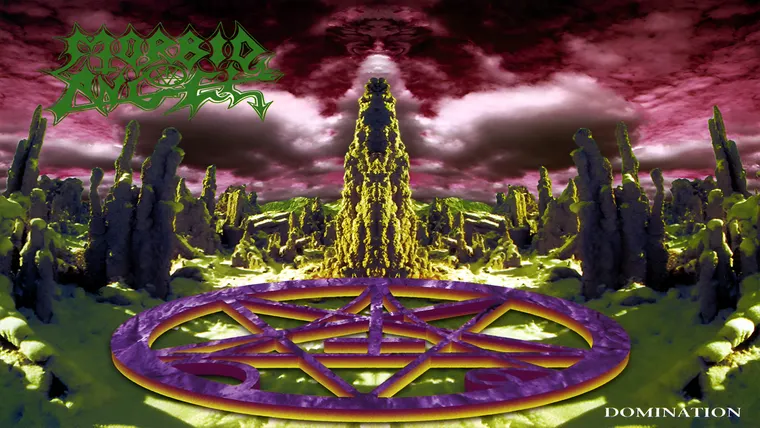
Released: April 25, 1995
By 1995, nobody needed Morbid Angel to prove they could play fast or make death metal sound crooked. Domination asks a trickier question: what happens when the band gives you time to remember the riff? The guitars leave bigger gaps, the choruses are easier to catch, and the strangest details no longer disappear into speed.
Domination was Morbid Angel’s fourth album and Erik Rutan’s first with the band. He joined David Vincent on vocals and bass, Trey Azagthoth on guitar and keyboards, and Pete Sandoval on drums, then ended up contributing to five songs. Bill Kennedy’s co-production gives the instruments sharp edges. The kick drums click through the low tuning, cymbal hits stay crisp, and Vincent’s bass sits close to the rhythm guitars, widening the bottom end whenever the riffs slow down. Even when Sandoval takes off, the mix lets you follow what everyone is doing.
“Dominate” lays out the change within seconds. Each palm-muted hit is clipped by a cymbal choke before the band breaks into rapid picking. When that opening figure returns, it still sounds blunt and easy to recognize. “Where the Slime Live” pushes the idea further. Its low seven-string riff bends, pauses, and comes back with a squeal hanging over it. Sandoval’s double kick churns beneath the gaps, filling the floor under that simple, ugly rhythm. The crooked shape is the hook.
That clarity suits Vincent. His consonants bite through the mix, and he stretches key words into a deep, theatrical bellow. The lyrics come as declarations. “Dominate” treats weakness as something to be purged, “Where the Slime Live” points at corruption spreading through poisonous words, and “Inquisition (Burn with Me)” turns religious punishment into a chant. Vincent writes from inside a hostile belief system, repeating its slogans until the ugliness becomes part of the rhythm.
Rutan also brings a different kind of melody. “Eyes to See, Ears to Hear” moves from a fast opening into an oddly tuneful guitar line, while Vincent places a low murmur against his main roar in the chorus. “Nothing but Fear” and “This Means War” stick to more direct death metal structures, but the two-guitar lineup gives the riffs cleaner divisions. Rutan’s leads move in deliberate shapes. Azagthoth still sounds as though he is pulling the notes sideways with the whammy bar. Bill Kennedy’s mix leaves enough room to hear the difference.
The real test comes when the songs stretch out. “Caesar’s Palace” lets its opening develop over a longer span, returning to huge chord figures while Sandoval fills around them instead of merely keeping time. “Melting” and “Dreaming” briefly replace the full band with uneasy keyboard tones and open space. Then “Hatework” begins with timpani and funereal orchestration before the guitars enter, turning Rutan’s original interlude idea into a full song. Vincent delivers the title like a ritual response as the arrangement grows around him. The song keeps expanding, and that repeated title makes even its largest moments easy to follow.
So, what happens when Morbid Angel gives you time to remember the riff? You hear how strange the riff actually is. The pauses in “Where the Slime Live,” the split vocal tones in “Eyes to See, Ears to Hear” and the timpani-led rise of “Hatework” remain clear because each has a shape you can recognize. By slowing down long enough to repeat those details, Morbid Angel gives every warped bend, kick-drum click, and Vincent command time to sink in.
A ThisDayInMetal exclusive by Rob Joncas, founder of DeadNoteMedia.
