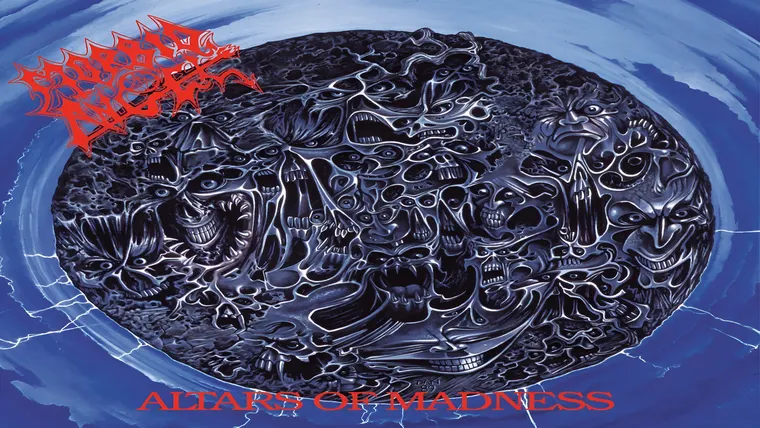
Released: May 12, 1989
How does music this unruly leave such clear shapes behind? Altars of Madness rarely stays with one riff for long. Pete Sandoval jumps from blast beats to double-kick runs and sharp stops. Trey Azagthoth and Richard Brunelle stack tremolo lines, hard-picked patterns, and wild leads until the songs seem ready to come apart. Yet “Immortal Rites” is recognizable within seconds. So are “Maze of Torment” and “Chapel of Ghouls.” Sheer chaos would not leave that kind of memory behind.
“Immortal Rites” gives the first clue. The opening guitar figure has a dark, ceremonial pull, but the band soon starts reshaping it at higher speed. David Vincent enters with a long, low growl while the guitars keep changing underneath him. When Azagthoth’s lead starts shrieking and diving, the rhythm guitar holds the main figure in place. The solo can go almost anywhere because the song has already given the ear something solid.
“Maze of Torment” pushes that idea further. Sandoval drives one riff at full speed, snaps to a different pulse, then leaves enough room for Vincent to spit out the title. Those words reset the listener before the next turn. “Chapel of Ghouls” works with broader movements. Its opening riff lumbers, the middle drops to a slower and uglier guitar passage, and then the drums set everything moving again. The riffs are blunt and easy to pick out. The surprise comes from how quickly one becomes another.
Sandoval controls those changes without making them sound tidy. On “Suffocation,” the drums lock into the churning guitar rhythm, break away for sudden bursts, then catch the riff again somewhere farther down the line. “Bleed for the Devil” squeezes the same thinking into a little over two minutes. The song charges forward, but the accents keep knocking its main pattern off balance. Sandoval is not simply playing fast. He keeps changing what the guitar riff does to the body.
Vincent helps make the songs readable. His bass thickens the lower edge beneath guitars that spend plenty of time scraping through the upper mids. His voice does even more. He stretches some words across the riffs and drives shorter phrases directly onto the beat. Even when a full line disappears inside the speed, the song titles come through.
That directness suits the lyrics. “Chapel of Ghouls” puts its violence inside a church and follows the destruction through the room. “Immortal Rites” uses a repeated invocation as part of the arrangement. Rites, possession and blasphemy are described through physical actions and clear images. Vincent sounds caught up in them, as though the ritual is happening around the microphone.
Tom Morris’s engineering and mix preserve the crowded sound. The guitars have grain, the cymbals spill across Sandoval’s attacks, and Vincent’s vocals sit among the instruments. The record can sound messy at the surface, but the important changes remain audible. A rhythm riff stays present under a lead. The kick drums accelerate beneath both guitars. Sudden gaps hit because the surrounding space is already packed. All four players occupy the same narrow strip of air, which makes every turn sound physical.
So how does Altars of Madness stay memorable while moving this wildly? Morbid Angel give the ear a few fixed points in every song: an opening figure, a title delivered at the right moment, a drum cue, and a riff worth waiting for again. The arrangements get tangled on the way back to them. By the end, those riffs are lodged in your head even if the route between them still makes no sense.
A ThisDayInMetal exclusive by Rob Joncas, founder of DeadNoteMedia.
