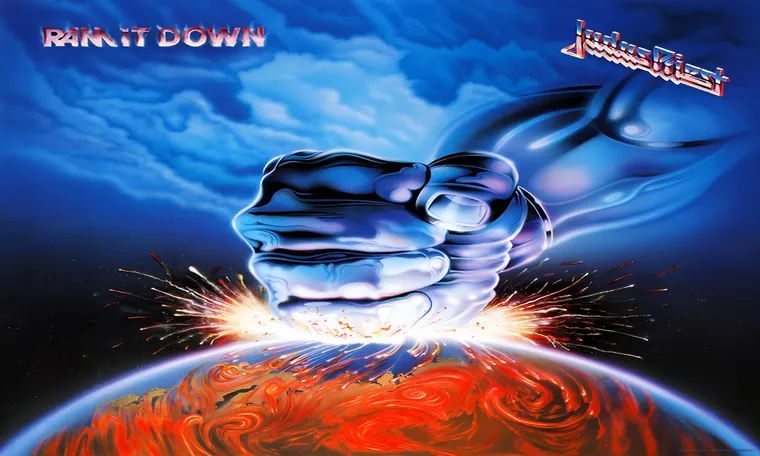
Released: May 13, 1988
How do you prove you’re still Judas Priest after Turbo? Ram It Down answers by turning everything up: faster tempos, higher screams, more solos, and enough metal in the lyrics to make the point impossible to miss. The title track begins with Rob Halford holding a scream over the first rush of guitars. Glenn Tipton and K.K. Downing then tear through an extended lead exchange before the main riff has time to take root. Cars, leather, decibels, and “a million guitars” fill the lyric. Priest are making their case in capital letters.
The sound still belongs to the same late-’80s studio world as Turbo. Tom Allom gives the guitars a bright, compressed edge, while the largely programmed drums land with near-uniform force. Ian Hill’s bass fills the centre beneath that rigid grid. “Hard as Iron” benefits from the precision. Its riff moves in short, clipped bursts against a rapid kick pattern, while Halford jumps from barked commands to piercing high notes. The machinery is impossible to ignore, yet a song about cold metal and destruction can use it.
Elsewhere, the band keeps saying the quiet part out loud. “Heavy Metal,” “Come and Get It,” “I’m a Rocker” and “Monsters of Rock” all turn identity into a chorus. “Heavy Metal” begins with a flash of lead guitar before settling into a broad, descending figure. “Come and Get It” uses stop-start accents and a direct crowd response. The hooks are clear, but the writing sometimes resembles stage banter stretched into complete songs. By the time “I’m a Rocker” comes around, Priest have identified themselves so often that they have left little room for surprise.
“Blood Red Skies” changes the terms of the argument. It keeps the digital surface of Turbo and places it inside a dystopian chase. Halford begins in a controlled lower register, moving through a shattered city watched by laser eyes. A synthetic pulse and restrained guitar figures delay the chorus, allowing the arrangement to expand in stages. Synth textures widen the skyline, the vocals stack higher, and the guitars become more dramatic as the narrator makes his stand. Even the programmed beat belongs to the setting, matching the song’s cybernetic heartbeat. The technology becomes part of the world instead of another coat of studio polish.
The album often loses focus. The title track, “Hard as Iron,” “Love You to Death” and “Monsters of Rock” were written during the abandoned Twin Turbos period, and the joins remain audible. “Love You to Death” retains the glossy sexual strut of Turbo, using pauses and vocal asides to play up the joke. “Monsters of Rock” moves at a slow mechanical stomp, stretching a simple riff into something almost processional. Between them sits “Johnny B. Goode,” recorded for the film Johnny Be Good. Chuck Berry’s swing is straightened into oversized drums, keyboards, and polished guitar flash. It sounds like a soundtrack assignment pushed into a record already pulling in several directions.
Can Judas Priest prove who they are by turning every trademark up at once? No. The repeated references to metal and rock only reveal how badly they want to settle the question. The title track, “Hard as Iron” and especially “Blood Red Skies” answer it through the music: speed, rigid percussion, twin-guitar drama, and Halford changing character to suit each song. “Blood Red Skies” makes the strongest case because its synths, programmed rhythm, and huge production all serve one specific vision. Once that happens, nobody needs to be told they are listening to Judas Priest.
A ThisDayInMetal exclusive by Rob Joncas, founder of DeadNoteMedia.
