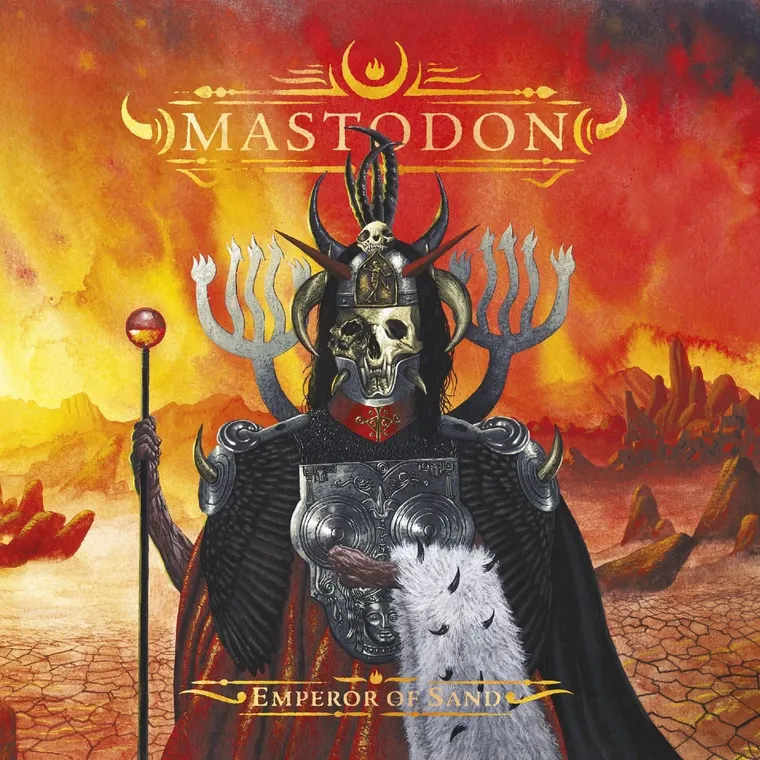
Released: March 31, 2017
How do you make an album about cancer without letting the disease consume the people living through it? Mastodon had no distance from that question while making Emperor of Sand. Bill Kelliher was writing beside his mother as she died from brain cancer. Troy Sanders’s wife was facing breast cancer, and Brann Dailor’s mother was being treated for lung cancer. Released on March 31, 2017, the album turns those experiences into a story about a condemned traveller crossing a desert while a ruler decides how much time he has left.
Brendan O’Brien, back after producing Crack the Skye, gives the band a clear, hard-edged sound with room for everyone to be heard. Kelliher and Brent Hinds remain distinct when their guitars overlap, Sanders’s bass rumbles below the fuzz, and Dailor’s kick drums and toms retain their shape during the busiest sections. The opening riff of “Sultan’s Curse” coils around Dailor’s restless drumming before settling into his wide, melodic chorus. Then the song breaks apart again. Nothing moves in a straight line for long.
“Show Yourself” runs on a brisk hard-rock pulse and puts mortality into the kind of chorus that sticks immediately. “Steambreather” is slower and stranger. Its low guitar figure lurches beneath Sanders’s rough verses while Dailor sings from a higher register. Their voices pull in different directions, which suits a record about people trying to stay hopeful while their bodies tell another story.
The real-life grief breaks through on “Roots Remain.” A hovering introduction drops into one of the album’s broadest riffs before Dailor’s clean voice takes over during a memory of sunlight and rain. Hinds’s solo bends and scrapes across the rhythm, then the song drops into a quiet, mournful coda. The memory interrupts the anger and leaves both unresolved.
Elsewhere, illness changes the sound of the album as much as the words. “Word to the Wise” places a knotty guitar pattern beneath one of Dailor’s largest melodies. “Ancient Kingdom” pushes its chorus upward while the bass and toms keep churning below it. “Clandestiny” brings in a robotic vocal and Kelliher’s synth guitar, adding a cold mechanical sound among all the sand, blood, and damaged breath. For a moment, the treatment room enters the desert.
Kevin Sharp tears into “Andromeda” for a few seconds, while Scott Kelly’s scorched vocal on “Scorpion Breath” lands over the song’s charging rhythm. Dailor fills the spaces around the guitar accents with quick snare hits and rolling toms. Even the faster songs sound hunted. The traveller can keep moving, but nothing in the music suggests that movement will change what is waiting for him.
“Jaguar God” begins with Hinds close to the microphone over acoustic guitar, his voice cracked and exposed. The full band gradually takes over with coiled riffs, abrupt turns, and a final solo that claws toward the end of the story. The wanderer reaches the fate promised at the beginning, with death and release arriving together.
So how does Mastodon keep cancer from erasing the people inside the story? The dragging riff in “Steambreather” catches the physical dread. The sudden memory inside “Roots Remain” belongs to the person behind the diagnosis. Hinds opening “Jaguar God” sounds like someone alone when time finally runs out. The desert gives Mastodon enough distance to write about cancer. Once inside it, every rough vocal, shifting riff, and break in the road points back to someone who had to live through it.
