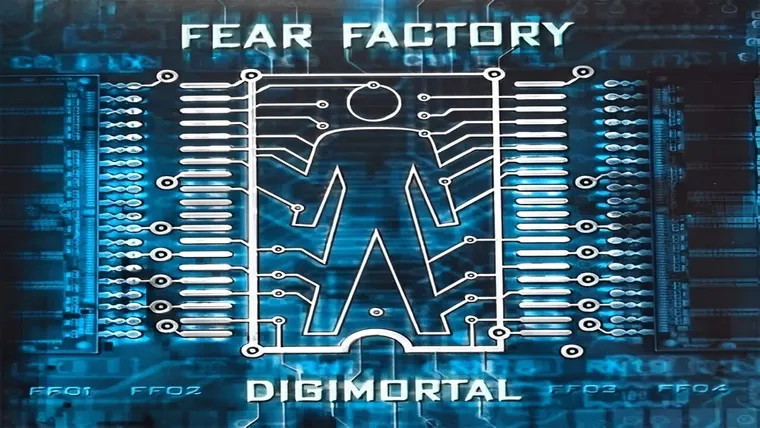
Released: April 24, 2001
Fear Factory spent the 1990s making machine music that still depended on four bodies. Dino Cazares and Raymond Herrera locked guitar and kick drum into the same rigid patterns. Christian Olde Wolbers filled out the bottom, while Burton C. Bell moved between an animal bark and clean, mournful singing. Digimortal raises a more interesting question than its science-fiction plot: how far could Fear Factory simplify that design before it stopped sounding like Fear Factory?
Released in 2001, the band’s fourth album kept Bell, Cazares, Wolbers, and Herrera together, with Rhys Fulber producing and adding keyboards and programming. Mike Plotnikoff handled the mix. The songs became shorter, the riffs more compact, and the choruses easier to find. Even the title reduced “digital mortality” to a single word that could fit across a CD cover.
“What Will Become?” places Jordan Plotnikoff’s child vocal inside a blunt industrial frame, a small human sound surrounded by machinery. Cazares cuts the main riff into short, low bursts, and Herrera follows its stops so closely that the drums sound programmed until one of his fills breaks the illusion. Bell asks what humanity becomes once it can see its own eternity. The music strips that question down to the band’s most recognizable movements.
That approach reaches its clearest form on “Linchpin.” The verse runs on a clipped guitar-and-kick pattern while electronic sounds flicker around the edges. Bell then opens the chorus with a broad clean melody, making the song sound larger without changing its basic construction. Wolbers stays close to the guitar, thickening the riff and giving the chorus a solid floor. The hook lands, repeats, and gets out.
The title track brings more colour into the same compact structure. Billy Sherwood helped arrange its vocal harmonies, along with those on “Invisible Wounds (Dark Bodies),” and Bell’s stacked voice softens the severe rhythm underneath. “Acres of Skin” interrupts its blunt chug with a glassy, effect-treated guitar passage. “Hurt Conveyor” moves in quicker, punk-sized bursts while Fulber’s electronics twitch behind the band. Small details keep the simpler writing from becoming one long, low-string pattern.
“Back the Fuck Up” shows where the idea starts to thin out. B-Real’s guest verse fits the album’s early-2000s surroundings, and the band gives him a wide, stomping groove. Guitar, drums, and vocals all push the same blunt phrase, leaving little rhythmic tension between them. The futuristic language also disappears, replaced by a confrontation that could have landed on several rap-metal records from the period.
More space helps elsewhere. Clean guitars and Fulber’s keyboards give “Invisible Wounds” an exposed, unsettled atmosphere, while Bell stays melodic for long stretches instead of saving that voice for a quick chorus. “(Memory Imprints) Never End” stretches past six minutes, bringing the bass forward beneath guitar harmonics, measured drums, and a long ambient coda. Its focus on preserving someone through memory gives the machine concept a personal purpose. Technology becomes a place to store grief.
So how far could Fear Factory simplify before losing their identity? Length and complexity could go. The friction between Cazares’ riffs, Herrera’s exact drum accents, Fulber’s electronics, and Bell’s two voices had to stay. “Linchpin” keeps all four in motion. “Back the Fuck Up” flattens them into one groove. “Memory Imprints” gives them room to separate again. That boundary tells us more about Digimortal than all the circuitry in its lyrics.
A ThisDayInMetal exclusive by Rob Joncas, founder of DeadNoteMedia.
