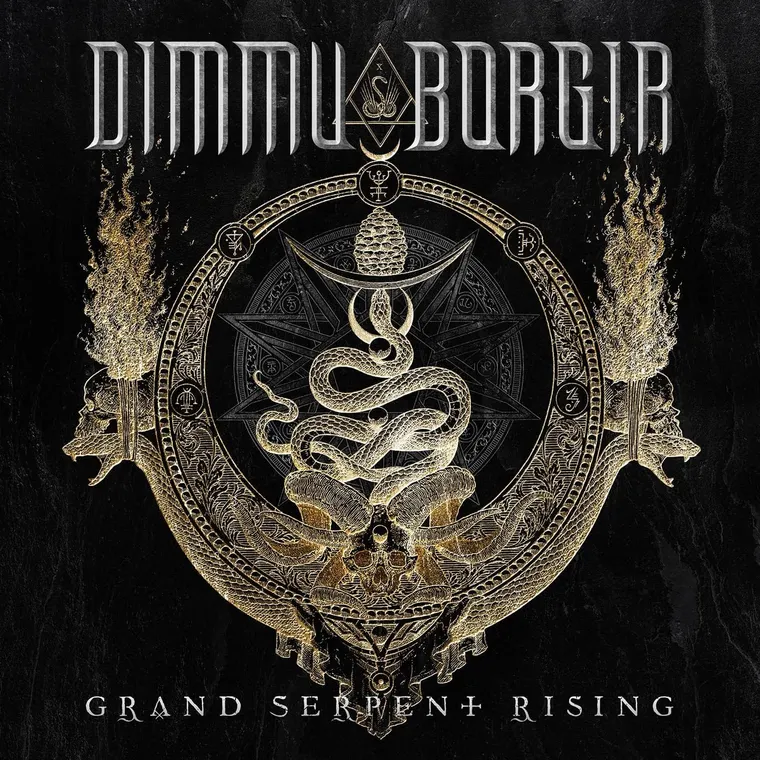
Eight years is a long time to wait for a record, and the longer a gap stretches, the harder it becomes to meet expectations that have been quietly inflating the entire time. Eonian in 2018 was a mixed bag — ambitious in places, overly polished in others, and not quite the return to form many listeners hoped it would be after the lineup upheaval that preceded it. By the time Grand Serpent Rising was finally announced earlier this year, the dominant feeling surrounding the band seemed to be cautious skepticism. That skepticism turned out to be misplaced. This is the most complete Dimmu Borgir record in over two decades, and it isn’t particularly close.
The creative core remains unchanged. Shagrath and Silenoz—the band’s central partnership since 1993—wrote all the music together, with Silenoz handling the lyrics. Around them sits a lineup that feels unusually stable: Daray on drums, Gerlioz on keyboards, Victor Brandt on bass, and Damage on guitars, the latter joining in 2025. The band reportedly spent years accumulating material before entering the studio, and that patience shows throughout the album. Nothing feels rushed or underdeveloped. Across thirteen tracks, the record commits fully to its own scale without losing cohesion.
“Tridentium” opens with cello and violin, cinematic and deliberately restrained before Shagrath’s clean vocals enter over a slow-building arrangement that gradually widens into something considerably heavier. It’s a patient introduction for a band that could easily have opened with pure force, and the restraint works in the album’s favour. “Ascent” follows and is the moment the record fully ignites—blast beats arriving with real menace, Shagrath shifting into the harsh register that defined the band’s identity, and riff work from Silenoz as sharp as anything on Puritanical Euphoric Misanthropia or Death Cult Armageddon. It was the correct choice for a pre-release single and will likely become the track most listeners associate with the album.
“As Seen in the Unseen” and “The Qryptfarer” maintain the momentum through the opening stretch, the former leaning further into atmosphere and melody while the latter pushes harder and faster, Daray’s drumming giving the track far more bite than much of the surrounding material. “Ulvgjeld & Blodsodel” was the lead single and marks the band’s return to Norwegian-language material for the first time since Stormblåst MMV. More importantly, it feels like a meaningful creative decision rather than a nostalgic gesture. The language changes the texture of the song itself, reconnecting the band to its earlier identity without sounding trapped by it.
“Repository of Divine Transmutation” stands among the album’s most structurally ambitious pieces, moving through multiple sections while keeping the orchestral layers embedded within the heaviness rather than floating above it. “Slik Minnes en Alkymist” slows the pacing considerably, functioning as a deliberate atmospheric pivot before “Phantom of the Nemesis” restores the aggression.
“The Exonerated” and “Recognizant” carry the second half confidently, with the latter emerging as one of the strongest tracks in the back portion of the record. Gerlioz's and Shagrath’s keyboard arrangements move in more harmonically interesting directions than much of Eonian, giving the material a greater sense of movement beneath the density. “At the Precipice of Convergence” and “Shadows of a Thousand Perceptions” gradually reduce the intensity before “Gjǫll” closes the album on an expansive and appropriately dark note, the orchestral and metal elements finally merging into one of the band’s strongest endings in years.
Thirteen tracks is a substantial ask from any listener, and the album could likely lose a small portion of its middle section without sacrificing anything essential. But the sequencing is strong enough that the record never fully falters, and the consistency of the material holds together far better than an album of this scale reasonably should.
The production is dense and symphonic without becoming suffocating, which is harder to achieve than bands operating in this style often make it sound. The guitars retain substantial weight beneath the orchestral layers, Shagrath’s vocals sit clearly in the mix in both registers, and the entire record sounds expensive without crossing into sterility.
Grand Serpent Rising is the record that justifies the years of waiting. Shagrath and Silenoz have spent three decades refining this version of Dimmu Borgir, and this is the album where that conviction feels fully restored.
