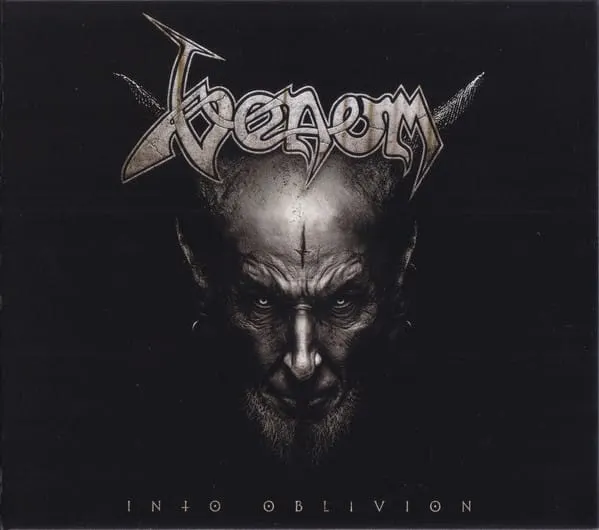
Talking about Venom in 2026 still means carrying the weight of everything attached to the name. The early records remain foundational in ways that are difficult to separate from extreme metal itself—Welcome to Hell and Black Metal continue to cast a long shadow over entire branches of the genre. But the band’s history also carries decades of lineup changes, uneven periods, and the recurring question of whether any version of Venom without the original trio can fully sustain the identity tied to it.
Into Oblivion doesn’t try to answer that question directly. It simply sounds unconcerned with it.
What stands out first is how settled this lineup has become. Eight years removed from Storm the Gates and nearly two decades into the Cronos / Rage / Dante era, the band no longer feels like a legacy act trying to maintain momentum through force of will alone. There’s a familiarity in the performances that comes from time rather than nostalgia. Cronos still anchors the entire record—the voice, the bass tone, the underlying attitude—but Rage and Dante no longer feel positioned around him as supporting players. The chemistry sounds earned.
The title track opens without hesitation. “Into Oblivion” moves immediately into attack mode, and the production gives the material more clarity than older Venom records ever aimed for while still retaining enough grime to avoid sounding overly refined. “Lay Down Your Soul” follows as the album’s clearest nod toward the band’s earlier eras, though it stops short of feeling self-conscious about it. The chorus is designed for crowd response, but the track has enough momentum to keep it from slipping into pure callback territory.
“Nevermore” strips things back down again—faster, harsher, and less interested in hooks than impact. “Man & Beast” and “Death the Leveller” continue in that same lane, both functioning as direct attacks without much interest in expanding outward. The pacing shifts slightly with “As Above So Below,” which slows just enough to let atmosphere settle into the edges of the track without softening it. “Kicked Outta Hell” immediately tears through that restraint again, leaning fully into the loud, reckless energy the band still handles naturally.
The second half broadens the tone without losing cohesion. “Legend” and “Live Loud” both embrace the album’s celebratory streak, but they avoid collapsing into self-mythology. There’s an awareness of history throughout the record, though it’s treated more like acceptance than performance. “Metal Bloody Metal” is blunt enough that its purpose is obvious from the title alone, but it moves quickly enough to justify itself. “Dogs of War” adds slightly more texture than the surrounding tracks, while “Deathwitch” and “Unholy Mother” close the album exactly the way a Venom record should close—loud, abrasive, and entirely uninterested in restraint.
Assuming the cover art is AI-generated, it would be a major misstep surrounding the release. For a band whose visual identity has always mattered almost as much as the music itself, the decision feels strangely disconnected from the rest of the record. It doesn’t damage the material, but it does create an unnecessary distraction around an album that otherwise feels unusually focused.
Into Oblivion doesn’t attempt reinvention, and it doesn’t rely entirely on the past either. What it offers instead is a version of Venom that sounds fully settled into itself—aware of the history behind it, but no longer trapped beneath it. After seventeen years with this lineup intact, that sense of permanence finally feels deserved.
