Judas Priest – British Steel: Less Was Always Going to Be More

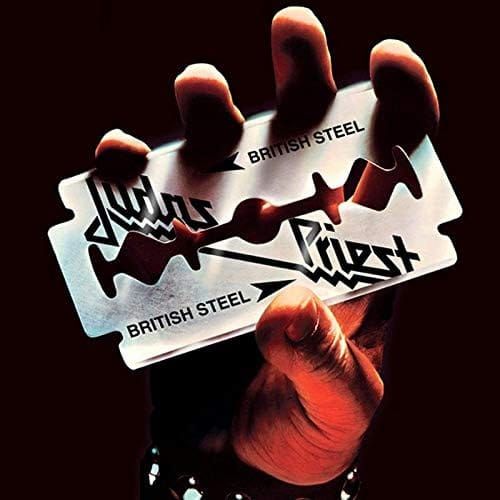
Released: April 14, 1980
Heavy metal in 1980 had a direction problem. The genre had spent most of the seventies getting heavier, longer, and more complicated, drifting toward prog on one end and pure volume on the other. Judas Priest looked at all of that and went the opposite way. British Steel is one of the most deliberate simplifications in rock history, and it worked so completely that the template it established is still in use today.
The band had been building toward this for a few albums. Stained Class and Killing Machine were both strong, but they still carried traces of the decade they were trying to leave behind. British Steel has no murk. It’s clean, direct, and structured around songs first—actual songs with hooks, choruses, and verses that stick after one listen. That sounds like a low bar until you realize how rarely metal bands clear it.
“Rapid Fire” sets the tone immediately—fast, tight, Rob Halford at full throttle before the album has time to breathe. It’s more a statement of intent than a standalone moment, the kind of opener that tells you to keep up. “Metal Gods” follows and shifts the approach, a mid-paced track built around a riff that feels mechanical, Halford’s delivery controlled and precise. It doesn’t try to overwhelm. It locks in and stays there. Then “Breaking the Law” arrives and the album pivots—two and a half minutes, one of the most recognizable riffs in the genre, a chorus that lands immediately and doesn’t let go. It’s as close to a perfect single as heavy metal produced in that decade.
“Grinder” and “United” carry the middle without losing momentum. “Grinder” leans harder, the rhythm section pushing underneath Glenn Tipton and K. K. Downing’s guitar work, while “United” stands as the clear outlier—anthemic, built for crowds, the kind of track that may have divided listeners at the time but has been validated by decades of live response.
“You Don’t Have to Be Old to Be Wise” gives the back half some breathing room, a steady mid-tempo groove before “Living After Midnight” delivers another immediate hook. It hits quickly, doesn’t overstay its welcome, and sounds like it could have been a number one single in a different version of radio. “The Rage” brings the aggression back up before closer “Steeler” finishes things with a riff-driven sprint that doesn’t linger.
What makes British Steel hold up isn’t any single element—it’s the consistency of the vision. Halford is at the peak of his range and restraint, knowing exactly when to push and when to hold back. Tipton and Downing aren’t playing for show; they’re playing for the songs. The production, handled by Tom Allom, is clean without drifting into sterility, something that wasn’t guaranteed in 1980. Everything sits where it should. Nothing competes for space.
The album runs under forty minutes and doesn’t waste a second. That kind of discipline is harder than it looks, especially for a band capable of doing more. The decision to strip things back, tighten the structure, and trust the songs is what separates British Steel from much of what surrounded it.
It isn’t the heaviest Judas Priest record. It isn’t the most complex. It’s the one that figured out what heavy metal needed to be—and got there first.