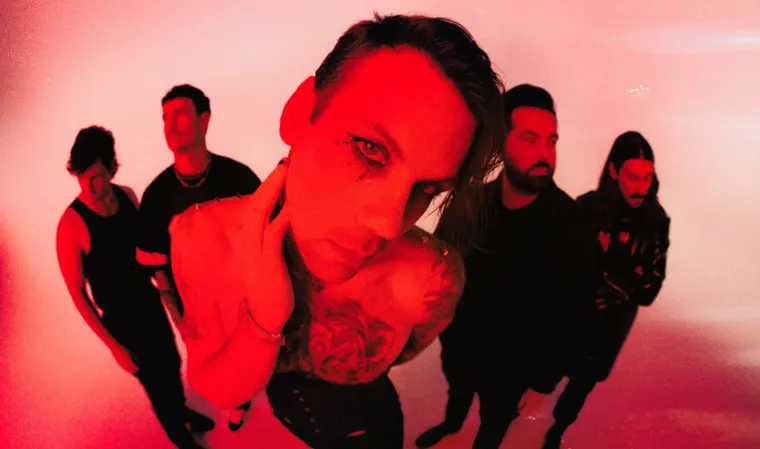
There is a particular kind of honesty that has always defined Beartooth. Even at their most aggressive, there has been something deeply human beneath the noise — a willingness to confront difficult emotions in such a way that allows listeners to find their own meaning within the songs.
Beartooth has never been particularly interested in making music that asks permission to be loud. Across the band’s catalog — which has often reflected frontman Caleb Shomo’s experiences, perspective, and personal evolution — heaviness has rarely been about sheer volume alone. It is about emotional physicality: the feeling that an aggressive riff can carry frustration, that a screamed vocal can communicate something that a clean vocal simply cannot, or that a chorus can feel cathartic when it arrives at exactly the right moment.
Pure Ecstasy still carries that same foundation, but it approaches it from a broader perspective.
The record retains the emotional weight and grit-fueled intensity listeners have come to expect from Beartooth, while making room for a greater sense of openness. New collaborators, unexpected influences, and different creative perspectives have all found their way into the process — and perhaps most importantly, Shomo has been willing to let other people into a creative space that he has traditionally occupied and held so closely.
Having had the opportunity to hear the record early, I was genuinely impressed by how naturally Pure Ecstasy balances the expected with the unexpected. There are moments that feel familiar to longtime Beartooth listeners, while others find the band and its collaborators pushing beyond established boundaries — experimenting with new sounds and textures without losing the identity that makes the band instantly recognizable.
Opening with the already-released title track, “Pure Ecstasy,” the album immediately establishes the weight longtime Beartooth listeners have come to expect while quietly introducing the larger story behind the record. Shomo begins with, “Sick and disgusting, this aggressive disease. Never discussing what a word of it means,” a line that points back toward the struggles expressed throughout the band's earlier records, particularly those released between 2013 and 2018. In that context, the song feels almost like a burial of the hardships and personal battles that shaped Beartooth's earlier chapters — and that sense of closure makes it an especially powerful way to begin the record. Backed by Shomo's commanding vocals and the band's visceral instrumentals, “Pure Ecstasy” establishes both the emotional and sonic foundation for everything that follows.
I had already spent time with Pure Ecstasy in its entirety before speaking with Shomo, so by the time we talked, I had a clear sense of what I was hearing. As a longtime Beartooth listener who has connected with the band's previous releases in my own way, hearing Shomo speak about the emotion and creativity poured into this record only deepened my appreciation for it. This is a record that can make you want to bang your head one moment and sit with the emotions beneath the music the next, rewarding listeners who approach it with an open mind.
“I don’t think there was one song on this record that I didn’t bawl my eyes out a few times in the process of recording. And also, if you’re not banging your head, what’s the point?” Shomo said.
That balance between emotional release and physical impact has become an important part of Shomo’s approach to songwriting. He pointed to the “headbang test” he developed while working with Nick Raskulinecz on Disease, using it as a simple but effective way to determine whether a song was doing what it needed to do.
“I had been working on it for a long time, and I had so many songs, and I was just very lost.” Shomo explained. He recalled taking the songs to Raskulinecz and watching his reaction in real time.
“Me and him are just sitting next to each other, just doing this. [Shomo headbangs] And then, literally the moment he would stop banging his head, he’d be like, ‘whoa, whoa, whoa, stop it, stop it!’ And he’d stop. He’d be like ‘I stopped banging my head. I stopped rocking. We’ve got to fix it.’ And that was his, like, barometer for working on a song.”
It may seem like a simple test, but it speaks to something fundamental about Beartooth’s music — the songs need to work both emotionally and physically. Pure Ecstasy may invite deeper reflection, but it never loses sight of Beartooth’s ability to provide a full body and mind listening experience.
My conversation with Shomo covered several topics that helped shape Pure Ecstasy: working with veteran producer Jordan Fish, his increasingly hands-on approach to instrumentation, his brother Luke’s creative involvement, and the larger questions surrounding artistic development, human creativity, and growing up inside an industry most people only encounter as adults.
That willingness to explore beyond what is expected of Beartooth is one of the defining qualities of Pure Ecstasy.

A Record Made With Nothing Left to Hide
The songs are finished. The performances are recorded. The artwork exists. The release campaign is underway. But the record is still, in a sense, private — a body of work that has occupied Shomo's world for months but has yet to belong to anyone else.
For Shomo, that means sitting in the unusual space between finishing Pure Ecstasy and preparing to take on the road for the first time.
I asked him how he was keeping himself sane during that downtime — and whether there were any particularly low-stakes hobbies keeping him occupied.
"Oh my goodness. I mean, staying sane is a tough one. I've honestly been doing a lot of just, like, playing music for the sake of music. I'm playing a lot more guitar, playing a lot more drums. Doing show practice, trying to exercise a lot. I love driving cars. I have a driving simulator thing that I do. Just stuff to try to get me in shape and ready for tour and occupy my mind so I don't go completely nuts." Shomo replied.
There is something intriguing about asking a musician how they're spending their downtime and discovering that “downtime” may not mean particularly much when your brain is wired to create.
That becomes even more apparent when looking at what Shomo has been posting online. Guitar. Drums. More guitar. More drums. Enough evidence, at least, to raise a serious question about the employment security of the other members of Beartooth. Are their positions safe, or is this upcoming tour about to become the "Caleb Shomo Solo Experience?"
So, naturally, I had to ask — for shits and giggles.
“[Shomo laughs] Oh, yeah, trust me, they're not going anywhere! I mean, yeah, you know, I've always played a lot of instruments, and I've kind of gone through phases where I'm, like, really leaning into them more and less. But honestly, I think it's good for the band as a whole, in general — when I'm playing a lot more, because I think we as a unit feed off each other.” Shomo replied.
The exchange is deliberately light, but his answer reveals something more meaningful about the way he approaches the band. Shomo's willingness to pick up different instruments isn't simply about proving that he can play them. It's another way of exploring an idea, challenging himself, and ultimately feeding that creativity back into the band as a whole.
“And also, like, nobody's gatekeepers or anything. I think the creativity feeds creativity, and then it pushes me, you know? I always want to be, like, pushing everybody. When I write a record on guitar, I want to see if I can push myself and push these guys. You know, it's just, it's good for everybody. They're my fucking boys. I love them.” Shomo concluded.
That collaborative energy is something that can be felt throughout Pure Ecstasy, even when Shomo's own hands-on approach it at the forefront.
New Creative Partnership
Speaking about the collaborative energy that encompasses this album becomes particularly interesting when discussing Jordan Fish, whose involvement brought another significant creative voice into the Beartooth world. His co-producing collaboration with Shomo on Pure Ecstasy represents one of the many intriguing aspects of this record.
After hearing Shomo describe their process, it was clear that his partnership with Fish went beyond the traditional producer-artist dynamic. I wanted to know what that kind of creative partnership actually feels like when you're standing in the room making the record.
“When Jordan's behind the wheel and on the computer, I have so much trust in him, and I have so much trust in his taste and his ability to know when a vocal is right. I would let him push me as far as he wanted to, and push myself as far as I could go,” Shomo explained.
Shomo speaks about how refreshing it felt to establish a level of trust with Fish — allowing him to let go of some of his hesitations and live more in the moment, focusing on his vocal takes rather than trying to wear the multitude of hats that come with producing.
“Vocally, I'm very proud of this record. I think we did some things that I didn't know I was capable of. I discovered a lot of range in my voice that I didn't even know I had, or that I could possibly do.”
That discovery has also come with its own challenge, which is taking those performances from the studio to the stage.
“I will say that has also been terrifying, because I've been having to learn how to do all that live. Thankfully, I live somewhere where I can yell and be very loud and work on that. But yeah, it's just all good.”
For Shomo, that process ultimately comes back to the value of having another musician in the room who can challenge him.
“Iron sharpens iron. I don't think I was going to get as good of a vocal experience alone as I did with him. That's just the truth.”
Keeping It in the Family
Another creative relationship that contributed to Pure Ecstasy is Shomo's work with his brother, Luke.
Luke created the artwork for Pure Ecstasy, establishing a visual representation of the emotional weight and personal journey behind the songs themselves. The cover's palette of reds and blacks seems to reflect the same passion and tension that's present in the music — making it one of the band's most captivating covers yet.
I asked Shomo how he sees that visual palette translating the contrast between the record’s aggressive breakdowns and its more melodic moments.
"I mean, I think it's honestly a very obvious representation of what this record is. With the cross, with the broken mirror, and with me with the makeup on in the background, and then it all being in this, like, faded red. It's just… it's expressing this chaotic period that I was going through, and this big transformation, and, you know… the death of some things and the birth of others." Shomo replied.
But Luke's contribution is about more than simply creating an image for the front of the record.
"I mean, I've been… just with what had been going on in my life, he's the person I've been talking to the most about it, and… he knows me, and he knows my heart, and he really has gotta know more than anybody on this planet what this record really means. And, yeah, I think he just translated it into this insane… visual moment. That, you know, I probably would have been too scared on my own to approve or to let happen, and… But I just knew it was right, and it was just the truth."
There is a particular kind of honesty that can come from working with family. While there is familiarity, there is also an ability to be completely vulnerable and trusting in a way that allows you to feel more supported throughout the process.
I asked Shomo what it is like to create alongside someone who knows him so well.
"I never would have been able to capture it in my own light. And I think it's opened up my mind… I mean, this whole record process has really opened up my understanding of the importance of collaboration."
The collaborative relationships involved in this record come together like puzzle pieces, ensuring that its many elements can coexist without losing sight of the larger picture. Pure Ecstasy can be brutally heavy without becoming emotionally closed off, and melodic without sacrificing its weight. It can welcome outside collaborators without losing its identity, while also giving family a meaningful place within the creative process.

Growing Up Inside Music
Shomo recently spoke about Hayley Williams' discussion of “arrested development” — the idea that entering the music industry very young can complicate the normal process of growing up.
For Shomo, the reference hit close to home, as he recently described the experience as "hitting him like a truck" on the Disrespectfully Podcast.
Similar to many artists of his generation, Shomo grew up not only listening to the music industry, but actively participating in it. The teenager who once spent his summers playing festivals like Warped Tour is now a veteran songwriter, performer, and producer, making decisions about his work from a very different place.
With that evolution in mind, I wanted to shift the conversation toward what he has gained from those years rather than what he may have missed along the way. I asked what positive lessons and artistic strengths he feels he has developed from growing up inside the creative industry.
"I mean, you definitely learn to filter out the noise. I mean, you kind of have to, to some degree." Shomo explains.
There are obvious challenges that can come with spending your formative years inside an industry built around performance and expectation, but there is also a level of personal growth that can only come from that experience.
"It's taken a long time, but I'm very proud of how we run as a unit on the road, and the amount of respect we all have as an entire unit. You know... from the band, to the tour manager, to the production assistant, to the techs. There's so many people that work so hard, and have dedicated their lives to this craft. So, you know, just through experience and seeing good camps and bad camps, being able to — in my opinion, we have a really good thing going. It's very based on respect and just the love of your job. And, yeah, that's another good thing I've taken from it."
And perhaps that is part of why Pure Ecstasy feels so deliberate. This isn't the record of someone trying to figure out whether or where he belongs in music. It's the record of someone who has spent years learning how to exist within it and is now becoming more intentional about which parts of that experience he wants to carry forward.
The Human Part of the Process
That question of what belongs in the creative process becomes even more complicated when technology enters the picture.
The “Bullshit” lyric-video incident brought Shomo into a conversation that artists across every medium are currently being forced to have: where does technology become something different from being used as another tool?
When Shomo learned that AI had been used in the creation of the lyric video and that he and his bandmates had been misled about it, he pulled its release. His brother, Luke, then remade the video overnight.
"We have no interest in using Al or artists lying about using Al to try to translate the blood, sweat, and tears that were put into this album in any way shape or form." Shomo said in a statement shared on the band's social media.
Luke's response made the distinction especially clear. When the original video no longer reflected the hard work behind the record, he took the time to create something that did.
As a visual artist myself, I was interested in hearing Shomo's perspective on the situation and how an incident that could have easily become a setback ultimately led to an outcome that felt more meaningful.
"I think there can be a whole big conversation on it. You know, I think my stance is maybe a little more nuanced, but I think, at least for this specific application of something like generative AI, it's just not something I want to be a part of this project. The whole point of Beartooth is me being able to connect with my humanity more through the best medium that I can use to express myself, which is music. And I want the rest of the experience to reflect that, to reflect the effort, and the love, and the humanity that was put in it. And thankfully, you know, Luke came in and was able to be convinced with, you know, being mailed cigarettes and a good pay check to stay up all night and kill this fucking thing, and he did. And now we have something we're very proud of." Shomo shared.
The important distinction here isn't simply whether someone is “for” or “against” AI. In the context of this particular incident, the conversation is ultimately about the people behind the work and the real efforts that went into creating it. Who made it? Who put the time into it? Who made the mistakes and the creative choices? Who cared enough about the final result to stay awake until morning making it right?
For a record like Pure Ecstasy, that question feels particularly relevant because it's so physical. You can hear and feel it in the raw emotion and grit of Shomo's vocals, in every drum progression building toward a breakdown, and in the tension between the aggressive guitar and bass riffs.
These aren't abstract qualities. They come from people collaborating, experimenting, and making creative decisions in real time. Some of the record's most effective moments work so well because they don't feel perfectly calculated.
That doesn't make Pure Ecstasy less polished. It makes the polish feel human.
When the Conversation Gets Personal
At some point, our conversation stopped being entirely about making a record.
The questions about songwriting, production, and collaborators gave way to something quieter — a brief heart-to-heart about human connection, supporting the people around us, and how something as simple as sharing your own experiences can have a meaningful impact on someone else's life.
I won't share the specifics of that conversation, but what stayed with me wasn't necessarily what was said. It was the sincerity behind it. There is an inherent performance to any interview. Someone asks a question, someone answers it, and both people understand that the conversation will eventually become something other people read. For a moment, all of that felt distant as we wrapped things up, and the conversation felt less like an interview and more like two people sharing a moment.
That moment also reinforced something important about the way Shomo has approached this period of his life. Despite the noise surrounding him, he has continued to live openly and authentically without losing the down-to-earth qualities that make him who he is. His identity is not something that needs to be approved of, explained away, or turned into a debate. It is simply one part of the person making the music, and it deserves the same basic respect as every other part of his life.
And that distinction matters, because Pure Ecstasy doesn't need to be reduced to any single aspect of Shomo's life. It is a record shaped by his experiences, relationships, confidence, uncertainty, self-acceptance, frustration, and continued growth, all of which inevitably find their way into the work.
Hearing the Record Differently
After speaking with Shomo, I went back to Pure Ecstasy.
Not because I suddenly needed an explanation for it. The music already speaks for itself, but context has a funny way of changing what you notice.
Pure Ecstasy is the feeling of being completely immersed in something — the moment when a riff lands exactly where it needs to, when a chorus opens up, when a breakdown finally arrives, or when a vocal performance goes further than expected.
And perhaps that's part of what Shomo has been chasing.
Not perfection. Not validation. Not another opportunity to prove that Beartooth can still make a heavy record. Something closer to the feeling of creating something simply because he genuinely wants to hear it exist in its most honest form.
The Record Speaks for Itself
For all of the conversations surrounding Pure Ecstasy — the collaborators, the artwork, the AI incident, the social media discussion, and the expectations surrounding another Beartooth record — there is eventually one unavoidable fact. The record has to stand on its own.
And it does, carried by a collaborative team that has clearly pushed the band in new directions without losing what makes it Beartooth.
The opening title track, Pure Ecstasy, establishes a compelling introduction to the story the record is about to tell. Eyes Closed delivers hard-hitting riffs and a breakdown that makes it nearly impossible to sit still, while a song like Beautiful Again begins to showcase some of the record's more exploratory qualities.
You may be the record's heaviest moment, opening with a progressive build before throttling straight back into that classic Beartooth bite. Then there's For Me By Me, a song that initially took multiple listens to fully reveal itself but has since become a constant listen for an entirely different reason — it's just that damn good. Lyrically, instrumentally, and in the way it continues to build throughout, it has become a standout track for me.
Ultimately, Pure Ecstasy gives listeners plenty of opportunities to experience the music physically — whether that's through full-body headbanging or getting lost in the quieter moments — while allowing space for the lyrics to take on personal meaning, even when a listener's own experiences differ from Shomo's.
That balance may be the record's greatest achievement.

Let the Record Become Yours
Beartooth's music has always connected with people because listeners have been able to find pieces of their own experiences within it.
Once Pure Ecstasy is released, Shomo won't be able to control what people take from these songs, nor should he have to. I asked him what he hopes happens once the initial noise surrounding the album rollout begins to fade — when people can put aside the external conversations and simply connect with the music in whatever way feels meaningful to them.
"In my opinion, this is as Beartooth as a Beartooth record has ever been, since... probably the first one, maybe Disease?" Shomo began.
There will inevitably be noise around Pure Ecstasy. There will be debates over singles, comparisons to previous records, and conversations about its production. But eventually, those conversations become secondary to the experience of actually listening.
"I just really hope that at the end of the day. Whether people get it or not, whether people agree with it or not, that they can at least just look at the art for the art. And, look at the music for the music."
There will be people who love it immediately and others who may need more time with it. That's how records become people's records. Eventually, everything surrounding the release starts to fade into the background.
What remains is what the music means to them.
Finding the Joy in the Chaos
After hearing Pure Ecstasy early and then sitting down with Shomo to talk about the process behind it, I keep coming back to the same conclusion.
This record doesn't sound like a band trying to convince anyone that Beartooth still belongs in the conversation. It sounds like a band that already knows who it is — and a songwriter increasingly becoming more comfortable exploring what else that identity can hold.
There is Jordan Fish pushing Shomo beyond his established boundaries. There is Luke bringing another creative perspective into the record. There is Shomo picking up different instruments simply because he can and following ideas wherever they lead. All of those things add to the story behind Pure Ecstasy, but none of them are necessary to enjoy the record itself.
You can hear it without knowing any of this. The guitars still hit. The drums hit harder. The breakdowns still land. The choruses are still undeniably catchy. Shomo's voice still carries the raw emotional weight that listeners have come to know and love.
After spending time with the record and hearing Shomo speak about everything that went into making it, I'm even more impressed by the finished product than I was during my first listen. Whatever listeners ultimately take from Pure Ecstasy, the record becomes theirs the moment they press play — and perhaps that's exactly what Shomo hopes for.
Rating: 9/10
Standout tracks: Pure Ecstasy / Eyes Closed / You / For Me By Me
Keep Up With Beartooth
Beartooth's Pure Ecstasy is released August 28, 2026 via Fearless Records.
Beartooth will hit the road this fall for the Pure Ecstasy World Tour. For tickets, tour dates, new music, merchandise, and additional information, visit: https://www.beartoothband.com
Fans can also follow Beartooth on their official social channels for tour updates, new music, behind-the-scenes content, and announcements.